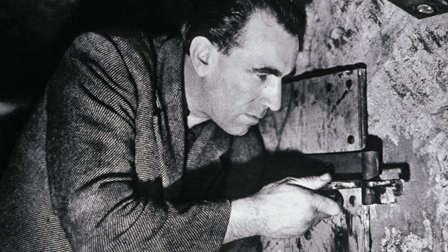
Thursday, 3 February 2011

Full Unemployment Cinema Screening at the Really Free School

Wednesday 9th February 2011, 2pm

5 Bloomsbury Square

London WC1A 2LX
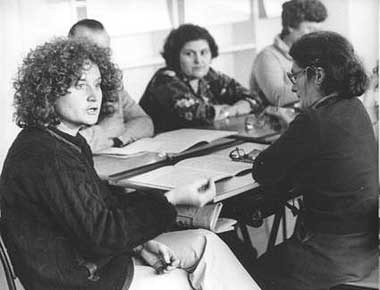


This screening features two films about alternative educational initiatives carved out from the drudgery of work time


Bred and Born

by Mary Pat Leece & Joanna Davis, 1983 (UK, 75 min)


Even if [this] film is a conversation, the editing makes it into a text. How is it possible to “give people a chance to speak for themselves” without then “using what they say to talk about what I think is interesting?” – Marina Vishmidt, BFI Screen Online

Bred And Born features four generations of women in an East London family who talk about their own experiences and close family ties, and a women’s group who discuss their roles as mothers and daughters. Moving between these two groups is a fictional storyline: an actress plays two distinct parts - a middle class researcher sent to East London to describe and define the role of the mother within the family, and a 19th Century educationalist advocating motherhood as woman’s ‘natural’ and primary purpose. Gradually, increasingly conflicting ideas disrupt ‘truths’ which seemed to be solid and unquestionable, as elements of class, race and economics become historically visible. Bred And Born acknowledges the differences between women - differences that we are born into and bred to act out - apparent differences between the language of feminism and the narratives of individual lives expressing the same oppressions but locked off from each other by language and tradition.’ (Joanna Davis, Mary Pat Leece, from the Cinenova catalogue).


Scuola Senza Fine / School Without End

by Adriana Monti et al, 1983 (Italy, 40 min)


‘I have been reading how in Italy between 1974 and 1982, there existed ‘150-hours courses’ which were available initially to factory workers and farmers, but eventually extended to housewives and pensioners.' - Emma Hedditch, ‘Now That We Are Persons’


After I had been working with a particular group of housewives for a year, we started shooting the film Scuola senza fine (literally, ‘School without end’) almost casually, in 1979. I was able to get equipment free of charge and money to pay for the film was made available. The women had taken the '150 Hours Course' and had been awarded the completion of secondary school diploma in 1976.

Watching the project develop was like uncorking a champagne bottle. The women’s writing matured and began to flow and sparkle while Lea, whose book L’infamia originaria was about to be published, did not write anything else for several years. The women students, encouraged first by Lea and the discovery of Freud, then by the other teachers and by science, philosophy, and linguistic analysis (visual, written, and body languages), filled page after page of their writing pads and exercise books, with personal reflections on culture, themselves, their families, nature, and feelings.

Introduction to the script of the film Scuola senza fine by Adriana Monti. Translated by Giovanna Ascelle: http://www.universitadelledonne.it/english/scuola%20senza%20fine.htm


http://reallyfreeschool.org

http://unemployedcinema.blogspot.com/

Monday, 31 January 2011

The Dubai in Me

The Dubai in me - a film by Christian von Borries

it's all online
Part one is here. You'll be able to find parts 2-9 from there.

from
the Dubai in Me website:

"At the heart of the saga - the Dubai debacle. (Nouriel Roubini)

Once the manic burst of building has stopped and the whirlwind has slowed, the secrets of Dubai are slowly seeping out. This is a city built from nothing in just a few wild decades on credit and ecocide, suppression and slavery. Dubai is a living metal metaphor for the neoliberal globalized world that may be crashing - at last - into the sands.

"The thing you have to understand about Dubai is - nothing is what it seems, nothing. This isn't a city, it's a con-job. They lure you in telling you it's one thing - a modern kind of place - but beneath the surface it's a medieval dictatorship." (Huffington Post)

Dubai or Palestine, Hanoi or Dubai: this film shows how wrong this antithesis is.

This film is searching for a new topography.

This film is a metaphore, a displacement, a shift where territories are marked, where things are seen, where they are given names and meaning. In this sense, the metaphoric task of cinema can be seen as subverting a previous metaphorical order, namely the official mapping of space and time. An order that defines places, that defines what has to be seen and done in those places, the way they are inhabited, their capacities and incapacities.

Tthe constructed picture of poverty and disgrace tends to take the edge of reality and should be preserved from any form of aesthetisation. Otherwise we make them acceptable and attractive.

Fiction and beauty should be the part of the rich, dull reality and the objectivity of the documentary look the part of the poor."

Tuesday, 18 January 2011

"Down with teachers! Up with revolution!” EDUCATION SPECIAL

Sunday 30th January 2011, 6PM
at Colorama
52-56 Lancaster Street,
SE1

FULL UNEMPLOYMENT CINEMA EDUCATION SPECIAL

This month Full Unemployment Cinema returns with an Education Special, in support of the ongoing education struggles happening in the UK and all over the world. We will screen a short selection of videos from education struggles; followed by a feature film and excerpts from 3 other films and documentaries, see details below.
Approximate running time: 2 hours.

With this screening we'd like to suggest going beyond the notion of a 'right to education', instead asking questions about the role of schooling in society, through works that look at different forms of kid rebellion against the restrictions of school institutions. What would a different form of education and transmission of knowledge look like?

FEATURE FILM:

Zero de Conduite / Zero for Conduct
by Jean Vigo 1933 (France 41 mins)

“War is declared! Down with teachers! Up with revolution!”

Zero de Conduite draws extensively on Vigo’s boarding school experiences to depict a repressive and bureaucratised educational establishment in which surreal acts of rebellion occur, reflecting Vigo’s anarchist view of childhood. The title refers to a mark the boys would get which prevented them from going out on Sundays.


As well as being intransigently radical, Zéro de Conduite is also deeply poetical, and much of the rebelliousness is whimsical to the point of seeming like a dream. In part, the dreamlike moments reflect circumstances of its production. As originally shot, the film was much longer than it was meant to be. In cutting it down to the required length, Vigo removed narrative material and left behind the most evocative scenes.

From: http://annares.wordpress.com


SHORT FILM:


En Rachachânt

by Straub/Huillet/Duras, 1982 (France 7 min)

En Rachâchant is a short film made by the esoteric director duo Jean-Marie Straub and Danièle Huillet. The text is adapted from a children’s story written by Marguerite Duras. It tells the story of a little boy named Ernesto who refuses to go to school because the school teaches things he doesn’t know.


Teachers on strike
by Cristina Ribas, 2010 (São Paulo/Rio de Janeiro (Brasil) 7mins)

19th March 2010: 70,000 protesters in the streets of the city of São Paulo. It's the teachers strike. For more than 3 hours, following down the big avenue Paulista, from MASP to Praça da República (where the state govern sets), teachers, students and several militants scream against the education policies that are reducing the rights to labour for the teachers over and over again. The demonstators transform the noisy city into a place for appearance and free expression but always, of course, closely observed by the state police.

EXCERPTS from:


Scuola Media

by Marco Santarelli Italy 2010
Set in the industrial outskirts of Taranto, Italy, the documentary film depicts life in the junior high school Pirandello and the work of teachers and the headmistress.


The Class
by Laurent Cantet, France 2008
Cantet’s feature film follows a year inside the classroom of one beleaguered public school teacher, played by none other than the real life Francois Begaudeau, in an urban middle school in Paris.


IF

by Lindsay Anderson, UK 1968
if.... is British drama film satirizing English public school life, depicting a savage insurrection at a public school, inspired by Zero de Conduite.

Sunday, 12 December 2010

ZOMBIE SPECIAL - (No Longer) A SURPRISE!

Sunday 19th December 6pm
At 56a Infoshop, 56 Crampton St SE17

Full Unemployment Cinema Zombie Special

Undead and abject, the zombie is uncontrollable ambiguity. Slouching across the earth, restlessly but with hallucinatory slowness, it is a thing with a soul, a body that is rotten but reactive, oblivious to itself yet driven by unforgiving instinct. – Lars Bang Larsen

For the final Full Unemployment Cinema screening of this year we have prepared a special themed screening around the celluloid body of the zombie. For what body better describes the unemployed negativity of the 20th century worker whose vicissitudes we continue to discuss and graves we continue to dig?

We will be screening some of our favourite zombie and horror clips as well as footage from zombie walks, flashmobs and music videos alongside a special feature: Carnival of Souls.

Mulled wine and snacks will be served.


Carnival of Souls, 1962 (US 78mins)

Carnival of Souls is a low budget 1962 horror film starring Candace Hilligoss. Produced and directed by Herk Harvey who produced industrial and educational films for the Centron Corporation based in Lawrence, Kansas. While vacationing in Salt Lake City, he developed the idea for the movie after driving past the abandoned Saltair Pavilion. Hiring an unknown actress, Lee Strasberg-trained Candace Hilligoss, and otherwise employing mostly local talent, he shot Carnival of Souls in three weeks, on location in Lawrence and Salt Lake City.


The film was made for an estimated $33,000, the movie never gained widespread public attention when it was originally released as it was intended as a B film and today, has become a cult classic. Set to an organ score by Gene Moore, Carnival of Souls relies more on atmosphere than on special effects to create its mood of horror. The film has a large cult following and occasionally has screenings at local film and Halloween festivals. Various prints of the film are in the public domain.

'In Carnival of Souls (1962), one place is allowed to be blatantly creepy: the amusement park where ghosts rest under the water and rise to dance. The rest of the world appears both normal and somehow wrong, and part of what is wrong about it—and within it, and encompassing it—is the liminal protagonist, Mary Henry (Candace Hilligoss). For she has gone wrong, and the world with her. It may be her subjective world, as in the Cocteau and Bergman films that producer-director Herk Harvey and screenwriter John Clifford admired, but it is ours as long as we are in the theater, and it looks too much like the real world outside the theater for comfort ... Aside from the music, the most artistically daring element of this film—one that defies a central convention of the horror genre—is its flight from romanticism, its concentration not on a foaming monster or on the hammering bosom of a Hammer heroine, but on a cold fish. If she is a magnet for the gothic, there is nothing exciting or sexy about it. The thrills of this carnival are cold ones, bits of death.' From Carnival of Souls by Bruce Kwin, read more: http://www.criterion.com/current/posts/76-carnival-of-souls

Trailer:


and in the mean time, here's a bit of reading:

Invasion of the Aca-Zombies
by Joseph Gora and Andrew Whelan
http://zombieacademy.wordpress.com/2010/11/03/invasion-of-the-aca-zombies/


Zombies of Immaterial Labor: the Modern Monster and the Death of Death

Lars Bang Larsen

via E-Flux, http://www.e-flux.com/journal/view/131

Undead and abject, the zombie is uncontrollable ambiguity.1 Slouching across the earth, restlessly but with hallucinatory slowness, it is a thing with a soul, a body that is rotten but reactive, oblivious to itself yet driven by unforgiving instinct.

It follows that if the zombie is defined by ambiguity, it cannot be reduced to a negative presence. In fact, it could be a friend. So why does it lend itself so easily as a metaphor for alienation, rolling readily off our tongues? Resorting to the zombie as a sign for mindless persistence is unfair to this particular monster, to be sure, but also apathetic and facile in the perspective of the historical space we inhabit.

My proposal, perverse or braindead as it may be, is that the zombie begs a materialist analysis with a view to contemporary culture. Such an analysis is necessarily double-edged. The zombie is pure need without morality, hence it promises a measure of objectivity; we know exactly what it wants—brains, flesh—because this is what it always wants. Abject monstrosity is naturally impossible to render transparent, but abjectness itself harbors a defined function that promises instrumentality (of a blunt and limited kind, admittedly). In this way we may proceed to address contemporary relations of cultural production, at the same time as we reflect on the analytical tools we have for doing so.

continue reading at this link.


Friday, 19 November 2010

FAR FROM POLAND

Far From Poland by Jill Godmilow, 1984 (106m)
Sunday November 28th at 6pm
56a Infoshop, 56 Crampton St London SE17

A filmmaker - a woman steeped in the documentary traditions of the Left - sets out to dismantle the sinister symmetry of the Cold War single-handedly and show the world the road to salvation through the miracle of the Polish Solidarity movement. When denied visas to shoot in Poland proper, she constructs a film in New York City called FAR FROM POLAND. Over the barest bones of documentary footage, she drapes dramatic re-enactments of Solidarity texts, formal vignettes and swatches of soap opera, to engage the audience in her personal, complex, contrary and contradictory understanding of the Polish struggle.


FAR FROM POLAND is probably the first American non-fiction film (Godmilow calls it a "drama-tary") to explode cinema verite's mythic claim to be the only trustworthy mode of representation for discussing the real world, and in particular, social and political issues, on film. Refused a visa to travel to Poland, "Jillski" (her Polish nickname in the film) has to literally re-invent the documentary to deal with the Polish situation and she does so with a particular eye to deconstructing not only documentary's specific claims to objectivity, but also the bourgeois audience's desire to sit comfortably in their seats, feel compassion, feel themselves part of the solution (not part of the problem) by having felt compassion for the poor oppressed Poles, who, Godmilow would argue, are far more acutely aware of their situation and what forces oppress them than the liberal American folk in the movie house.


In the course of the film, she interviews Polish exiles who try to help her "organize" some footage from Poland. She has long telephone conversations with Fidel Castro who wants her to stop making the film. (Fidel asks her, "Is it always going to be like this... is great art always going to be in conflict with the state? Jillski says, "I didn't want to break his heart so I didn't say a word.") She re-produces, with superbly performed re-enactment, four long, now famous interviews published in the Solidarity press - with Anna Walentynowicz, the fired crane operator for whom the strike started in the Gdansk shipyard; with ex-censor, K-62, who is now looking everywhere for a new job; with a Polish miner, interviewed by a reporter from the New York Times who can't quite fathom the notion of a "workers' movement in a workers' state"; and with General Jaruzelski (fictional), years after the imposition of martial law on his own people. There are Polish jokes, from both sides of the Atlantic and soap-operatic self-criticism. (Jill - explaining the Solidarity movement to her boyfriend Mark: "For 35 years, the Polish workers have been told that they own the means of production and now they're calling that bluff. They'll decide for themselves what to make, how to make it, and what it's worth." The phone rings - Mark gets it. He listens for a moment, then covers the mouthpiece, "It's Karl Marx, from Workers Utopia. He says, 'Jillski, come home.' Jill retorts, "Why do you have to turn everything into a goddamn joke?" Mark, "Because I don't have anything as important as Poland to hold my miserable little life together. I'm tired of you walking around seeing the goddamn light all the time. I'm tired of all these Poles sleeping on our sofa."

Wednesday, 17 November 2010

NOVEMBER FILM STILL TO BE DECIDED - Watch this space

The UnCine central committee have decided to postpone the screening of THE HOUR OF THE FURNACES (Octavio Getino + Fernando Solanas) for technical and complicated reasons. But we will screen it in 2011 at some point. So we are still deciding what film we will be showing on SUNDAY NOV 28th at 6pm at 56a Infoshop. So keep checking the blog or sign up for our email list and we will send you a message about the decision.

Tuesday, 12 October 2010

Men In Prison

Full Unemployment Cinema Prison Special
Sunday October 31st at 5.30pm - remember the clocks go back the night before!!

***IMPORTANT CHANGE OF VENUE FOR THIS SCREENING***
Was shown in a freezing ass cold squat in SE5!!

Harun Farocki, Gefängnisbilder aka Prison Images, 2000
Jacques Becker, Le Trou, 1960

With guest speaker John Barker
Author of Bending the Bars


Harun Farocki,Gefängnisbilder aka Prison Images, 2000 (60 mins)

A film composed of images from prisons. Quotes from fiction films and documentaries as well as footage from surveillance cameras. A look at the new control technologies, at personal identification devices, electronic ankle bracelets, electronic tracking devices. The cinema has always been attracted to prisons. Today's prisons are full of video surveillance cameras. These images are unedited and monotonous; as neither time nor space is compressed, they are particularly well-suited to conveying the state of inactivity into which prisoners are placed as a punitive measure. The surveillance cameras show the norm and reckon with deviations from it. Clips from films by Genet and Bresson. Here the prison appears as a site of sexual infraction, a site where human beings must create themselves as people and as a workers. In Un Chant d'amour by Jean Genet, the guard looks in on inmates in their cells and sees them masturbating. The inmates are aware that they are being watched and thus become performers in a peep show. The protagonist in Bresson's Un Condamné à mort s'est échappé turns the objects of imprisonment into the tools of his escape. These topoi appear in many prison films. In newer prisons, in contrast, contemporary video surveillance technology aims at demystification. (HF quoted on http://arttorrents.blogspot.com/2008/05/harun-farocki-gefngnisbilder-aka-prison.html)


Jacques Becker, Le Trou, 1960 (131 min)


In a Paris prison cell, five inmates use every ounce of their tenacity and ingenuity in an elaborate attempt to tunnel to freedom. Based on the novel by José Giovanni, Jacques Becker’s Le trou (The Hole) balances lyrical humanism with a tense, unshakable air of imminent danger.


Essays:
The Time It Takes: Le Trou and Jacques Becker by Chris Fujiwara
http://www.criterion.com/current/posts/138-the-time-it-takes-le-trou-i-and-jacques-becker
Le Trou by Darragh O’Donoghue
http://www.sensesofcinema.com/2006/cteq/trou/

THE RAT****
298 Camberwell New Road
London
SE5

Map: http://maps.google.com/maps?client=ubuntu&channel=fs&q=298+Camberwell+New+Road&oe=utf-8&ie=UTF8&hq=&hnear=298+Camberwell+New+Rd,+Camberwell,+Greater+London+SE5+0,+United+Kingdom&ei=dq7FTJWTIsuNjAf6_Nm5BQ&ved=0CBMQ8gEwAA&z=16