Friday, 15 June 2012

The Forgotten Space

Sunday 24 June | Doors 8pm | Admission Free

The Forgotten Space by Allan Sekula & Noël Burch
US/Austria/Netherlands, 2010, (111 mins)

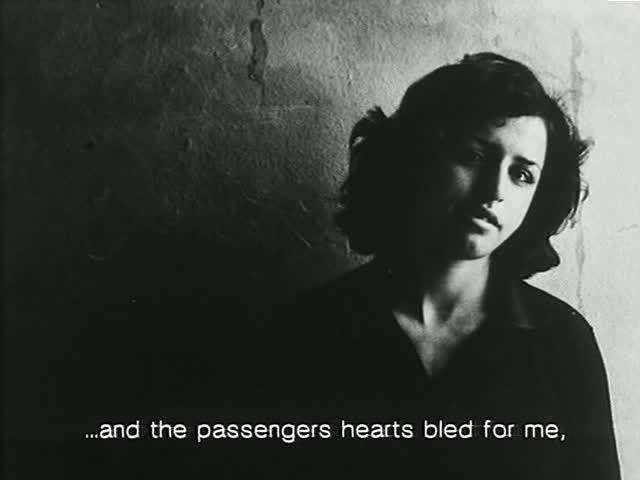
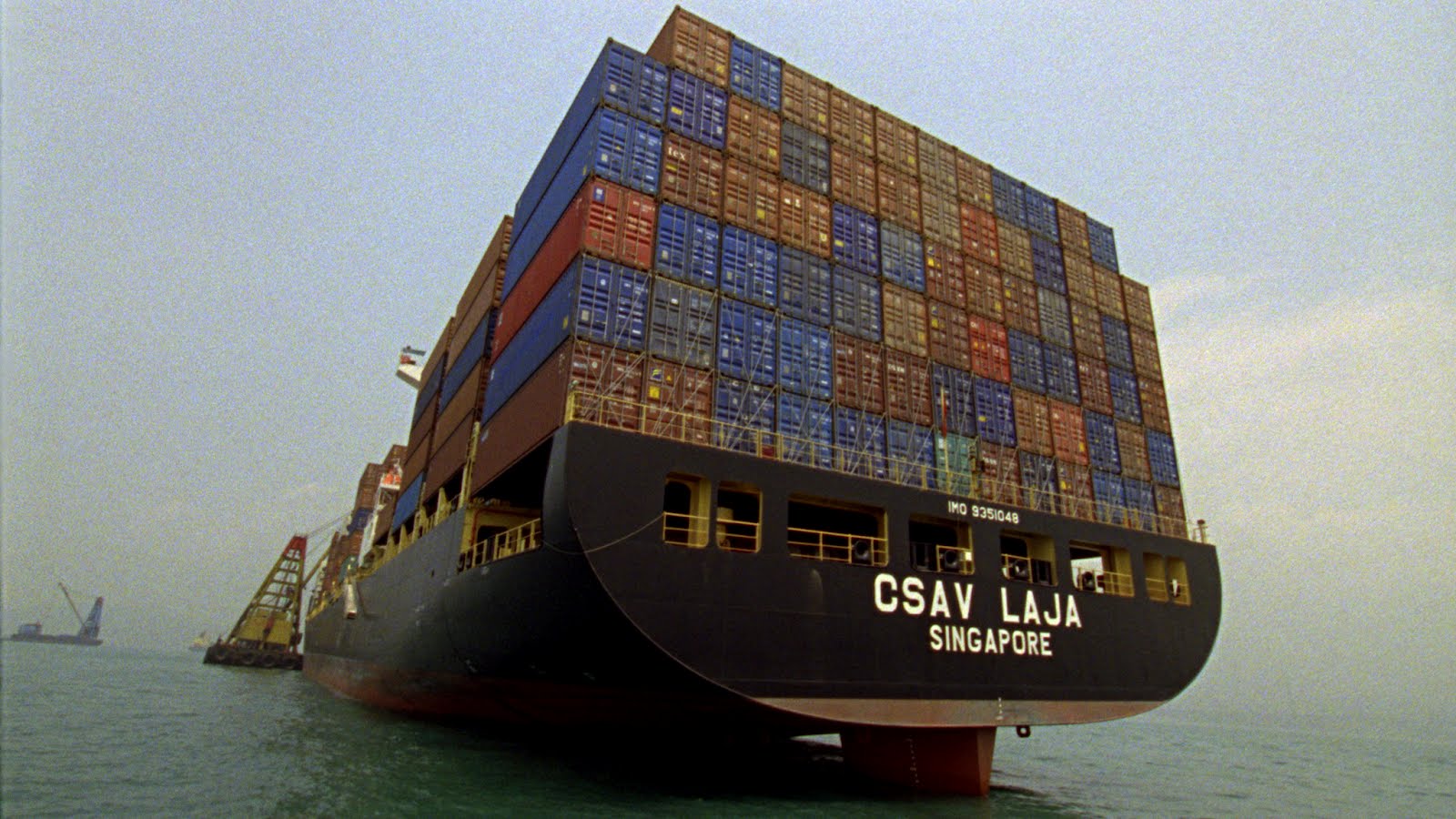
The sea is forgotten until disaster strikes. But perhaps the biggest seagoing disaster is the global supply chain, which – maybe in a more fundamental way than financial speculation – leads the world economy to the abyss.



New venue (TBC)

The Pullens Centre
184 Crampton street,
London SE17 3AE

Tube: Elephant and Castle  

Notes for a Film
by Allan Sekula & Noël Burch


Our film is about globalization and the sea, the “forgotten space” of our modernity. First and foremost, globalization is the penetration of the multinational corporate economy into every nook and cranny of human life. It is the latest incarnation of an imperative that has long been accepted as vital necessity, even before economics could claim the status of a science. The first law of proto-capitalism: markets must multiply through foreign trade or they will stagnate and die. As the most sophisticated of the 17th century defenders of mercantilism, William Petty, put it: “There is much more to be gained by Manufacture than Husbandry, and by Merchandize than Manufacture. A Seaman is in effect three Husbandmen.” (Political Arithmetick, 1690). The contemporary vision of an integrated, globalized, self-regulating capitalist world economy can be traced back to some of these axioms of the capitalist “spirit of adventure.” And yet what is largely missing from the current picture is any sense of material resistance to the expansion of the market imperative. Investment flows intangibly, through the ether, as if by magic. Money begets money. Wealth is weightless. Sea trade, when it is remembered at all, is a relic of an older and obsolete economy, a world of decrepitude, rust, and creaking cables, of the slow movement of heavy things. If Petty’s old fable held that a seafarer was worth three peasants, neither count for much in the even more fabulous new equation. And yet we would all die without the toil of farmers and seafarers. Those of us who travel by air, or who “go surfing” on the Web, scarcely think of the sea as a space of transport any more. We live instead in the age of cyberspace, of instantaneous electronic contact between everywhere and everywhere else. In this fantasy world the very concept of distance is abolished. More than 90% of the world’s cargo moves by sea, and yet educated people in the developed world believe that material goods travel as they do, by air, and that money, traveling in the blink of an eye, is the abstract source of all wealth. Our premise is that the sea remains the crucial space of globalization. Nowhere else is the disorientation, violence, and alienation of contemporary capitalism more manifest, but this truth is not self-evident, and must be approached as a puzzle, or mystery, a problem to be solved. The factory system is no longer concentrated in the developed world but has become mobile and dispersed. As ships become more like buildings, the giant floating warehouses of the “just-in-time” system of distribution, factories begin to resemble ships, stealing away stealthily in the night, restlessly searching for ever cheaper labor. A garment factory in Los Angeles or Hong Kong closes, the work benches and sewing machines reappear in the suburbs of Guangzhou or Dacca. In the automobile industry, for example, the function of the ship is akin to that of conveyor systems within the old integrated car factory: parts span the world on their journey to the final assembly line. The function of sea trade is no longer a separate, mercantilist enterprise, but has become an integral component of the world-industrial system. We are distracted from the full implications of this insight by two powerful myths, which stifle curiosity. The first myth is that the sea nothing more than a residual mercantilist space, a reservoir of cultural and economic anachronisms. The second myth is that we live in a post-industrial society, that cybernetic systems and the service economy have radically marginalized the “old economy” of heavy material fabrication and processing . Thus the fiction of obsolescence mobilizes vast reserves of sentimental longing for things which are not really dead. Our response to these myths is that the sea is the key to understanding globalized industrialism. Without a thoroughly modern and sophisticated “revolution” in ocean-going cargo-handling technology, the global factory would not exist, and globalization would not be a burning issue. What began in the mid-1950s as a modest American improvement in cargo logistics, an effort to achieve new efficiencies within a particular industry, has now taken on world historic importance. The cargo container, a standardized metal box, capable of being quickly transferred from ship to highway lorry to railroad train, has radically transformed the space and time of port cities and ocean passages. There have been enormous increases in economies of scale. Older transport links, such as the Panama Canal, slide toward obsolescence as ships become more and more gargantuan. Super-ports, pushed far out from the metropolitan center, require vast level tracts for the storage and sorting of containers. The old sheltering deepwater port, with its steep hillsides and its panoramic vistas, is less suited to these new spatial demands than low delta planes that must nonetheless be continually dredged to allow safe passage for the deeper and deeper draft of the new super-ships. Ships are loaded and unloaded in as little as twelve hours, compared to the laborious cargo storage practices of fifty years ago. The old waterfront culture of sailor bars, flophouses, brothels, and ship chandlers gives way either to a depopulated terrain vague or – blessed with the energies of real-estate speculators – to a new artificial maritime space of theme restaurants, aestheticized nautical relics and expensive ocean-view condominiums. As the class character of the port cities changes, the memory of mutiny and rebellion, of intense class struggle by dockers, seafarers, fishermen, and shipyard workers-struggles that were fundamental to the formation of the institutions of social democracy and free trade-unionism-fades from public awareness. What tourist in today’s Amsterdam is drawn to the old monument commemorating dock-workers’ heroic but futile strike to prevent the Nazi deportation of the Dutch Jews? If the cargo container represents one instrument of maritime transformation, the companion instrument is not logistical but legal. This is the flag of convenience system of ship registry. Here again, the Americans were in the lead, seeking to break powerful maritime unions in the wake of the second world war. If globalization is understood by many in the world today as Americanization , the maritime world gives us, then, these two examples of the revolutionary and often brutal ingenuity of American business practices. The flag of convenience system allows for ships owned in rich countries to be registered in poor countries. It was created to obscure legal responsibility for safety and fair labor practices. Today’s seafaring crews are drawn for the old and new Third Worlds: Filipinos, Chinese, Indonesians, Ukranians, Russians. The conditions they endure are not unlike those experienced by the lascars of the 18th century. A consequence of the global production-distribution system is that links between port and hinterland become all the more important. It is not just the port that is transformed, but the highway and rail system, the very transport infrastructure of a country or a continent, as evidenced by the Betuwe line in Holland or the dangerous saturation of truck traffic in Alpine tunnels. The boxes are everywhere, mobile and anonymous, their contents hidden from view. One could say that these containers are “coffins of remote labor-power” carrying goods manufactured somewhere else, by invisible workers on the other side of the globe. We are told by the apologists of globalization that this accelerated flow is indispensable for our continued prosperity and for the deferred future prosperity of those who labor so far away. But perhaps, this is a case for Pandora, or for her more clairvoyant sister, Cassandra. Our film moves between four port cities: Bilbao, Rotterdam, Los Angeles, and Hong Kong. It visits the industrial hinterland in south China, and the transport hinterland in the heart of Holland. Of the four port cities, three can be classed as “super-ports,” the largest in the world. Here we encounter functional hypertrophy. Bilbao, a fading port with a brave maritime history, has become the site of radical symbolic transformation of derelict maritime space. In Bilbao, functional atrophy coexists with symbolic hypertrophy, a delirium of neo-baroque maritime nostalgia wedded to the equally delirious promise of the “new economy.” Los Angeles, July 2010

Tuesday, 15 May 2012

News from Ideological Antiquity

Sunday 27 May | Doors 7pm | Admission Free


News from Ideological Antiquity 
Directed by Alexander Kluge, Germany, 2010, (84 mins)

Pamphlet of expanded materials about the film here

Alexander Kluge's film is a discursive essay about and around Eisenstein's notes on a film of Marx's Capital - written shortly after the release of October in 1927 and connected to his ideas for conceiving a film of Joyce's Ulysses. According to Helmet Merker writing on the 570 minute version, 'Eighty years on, Alexander Kluge joins the party and takes up where Eisenstein failed, because neither Hollywood's capitalists nor Moscow's Communists were prepared to send the necessary funds his way… Scholarly stuff, wide and deep in scope, yet bold and playful. But even if your own study of Marx is no more than a faded memory, it is hugely enjoyable to watch and listen to these experts… Alexander Kluge is a great manipulator, an industrious loom, who weaves the most far-flung observations into his system. He is not filming Das Kapital but researching how one might find images to make Marx's book filmable. The quest is the way is the destination… In Kluge's hands this becomes a collage of documentary, essayistic and fictional scenes, interviews and still photos, archive images of smoking factory chimneys, time-lapse footage of pounding machines and mountains of products, diary entries and blackboards scribbled with quotes referencing constructivism and concrete poetry…'

Marx and Montage


FREDRIC JAMESON

MARX AND MONTAGE

From New Left Review,  58, July-August 2009


It is always good to have a new Kluge, provided you know what lies in store for you. His latest film, News from Ideological Antiquity—some nine hours long—is divided into three parts: I. Marx and Eisenstein in the Same House; II. All Things are Bewitched People; III. Paradoxes of Exchange Society. [1] Rumour has it that Kluge has here filmed Eisenstein’s 1927–28 project for a film version of Marx’s Capital, whereas in fact only Kluge’s first part deals with this tantalizing matter. The rumour has been spread by the same people who believe Eisenstein actually wrote a sketch for a film on Capital, whereas he only jotted down some twenty pages of notes over a half-year period. [2] And at least some of these people know that he was enthusiastic about Joyce’s Ulysses during much the same time and ‘planned’ a film on it, a fact that distorts their fantasies about the Capital project as well. Yet if Eisenstein’s notes for film projects all looked like this until some of them were turned into ‘real’—that is to say, fiction or narrative—films, it is only fair to warn viewers that Kluge’s ‘real’ films look more like Eisenstein’s notes.
Many important intellectuals have—as it were, posthumously—endorsed Marxism: one thinks of Derrida’s Spectres of Marx and of Deleuze’s unrealized Grandeur de Marx, along with any number of more contemporary witnesses to the world crisis (‘we are all socialists now’, etc.). Is Kluge’s new film a recommitment of that kind? Is he still a Marxist? Was he ever one? And what would ‘being a Marxist’ mean today? The Anglo-American reader may even wonder how the Germans in general now relate to their great national classic, with rumours of hundreds of Capital reading groups springing up under the auspices of the student wing of the Linkspartei. Kluge says this in the accompanying printed matter: ‘The possibility of a European revolution seems to have vanished; and along with it the belief in a historical process that can be directly shaped by human consciousness’. [3] That Kluge believes in collective pedagogy, however, and in the reappropriation of negative learning processes by positive ones, in what one might call a reorientation of experience by way of a reconstruction of ‘feelings’ (a key or technical term for him): this is evident not only in his interpretive comments on his various films and stories, but also in such massive theoretical volumes as his Geschichte und Eigensinn—History and Obstinacy—written in collaboration with Oskar Negt.
All of these works bear on history; and of few countries can one say that they have lived so much varied history as Germany. Balzac’s work would have been impossible without the extraordinary variety of historical experience encountered by the French, from revolution to world empire, from foreign occupation to economic reconstruction, and not excluding unspeakable suffering and failure along with war crimes and atrocities. Kluge’s stories, or anecdotes, or faits divers—some thousands of pages of them—draw on a comparable mass of historical raw material.
But history is something you have to dig up and to dig in: like Kluge’s heroine Gabi Teichert in Die Patriotin, who literally gets out her spade and frantically excavates, scrabbling for clues to the past in bones and potsherds. And not necessarily in vain: in another film, the knee of a German soldier’s skeleton testifies and tells some ‘useful’ war stories. Indeed, News from Ideological Antiquity has its own share of zany or even idiotic moments—a pair of actors reading Marx’s incomprehensible prose aloud and in unison to one another, a ddr instructor explaining ‘liquidity’ to a recalcitrant pupil, and even a kind of concluding satyr play in which the (rather tiresome) comedian Helge Schneider plays a variety of Marx-inspired roles, complete with wigs, false beards and other circus paraphernalia. For as Kluge tells us, ‘we must let Till Eulenspiegel pass across Marx and Eisenstein both, in order to create a confusion allowing knowledge and emotions to be combined together in new ways’. [4]
Meanwhile, on a less jocular level, we confront a sometimes interminable series of talking heads—Enzensberger, Sloterdijk, Dietmar Dath, Negt and other authorities—as they confront the typical Kluge interview, part prompting, part leading questions, part cross-examining his own witnesses. We glimpse a weird project of Werner Schroeter, in which Wagner’s Tristan and Isolde is acted out through the conflict on the bridge in Battleship Potemkin (‘the rebirth of Tristan out of the spirit of Potemkin’); along with excerpts from operas by Luigi Nono and Max Brand, not to speak of the classics. We see a short by Tom Tykwer on the humanization of objects, sequences on the assassination of Rosa Luxemburg and, on a lighter note, an evening with Marx and Wilhelm Liebknecht. Many film clips and stills are interpolated, mostly from the silent period, and dramatic graphics from both Marxian and Eisensteinian texts make it clear that the intertitles of the silent period could be electrifying indeed, if resurrected in bold colour and dramatic typography. It is Kluge’s own version of the Eisensteinian ‘montage of attractions’ (this filmmaker might say ‘of feelings’). Viewers unaccustomed to his practices may well find this an unbelievable hodge-podge. But they too can eventually learn to navigate this prodigious site of excavation: not yet a full-fledged and professionally organized museum, this is an immense dig, with all kinds of people, amateur and specialist alike, milling around in various states of activity, some mopping their brows or eating a sandwich, others lying full-length on the ground in order to brush dirt from a jawbone, still others sorting various items into the appropriate boxes on tables sheltered by a tent, if not taking a nap or lecturing a novice, treading a narrow path so as not to step on the evidence. It is our first contact with ideological antiquity.

Eisenstein’s version

Among the more recognizable fragments is, to be sure, that ‘new work on a libretto by Karl Marx’, the ‘film treatise’ which was supposedly Eisenstein’s next project after October, the alleged film of Capital. As always, Eisenstein’s notes are so many reflexions on his own practice, past and future; characteristically, they re-read his own work as a progression of forms, like progress in scientific experimentation. There is no point leaving this narcissism unacknowledged—it is the source of much of the pedagogical and didactic excitement and enthusiasm of his writings; but we do not necessarily have to accept his own assessments of his career, especially since they varied greatly throughout his life.
Here, for example, he will read his work in terms of abstraction: as the progressive conquest of abstraction from Potemkin through October to the current project. (We might have preferred him to characterize it as the enlargement of his filmic conquest of the concrete to include abstraction, but never mind.) Predictably, we move from the rising lions in Potemkin to that ‘treatise on deity’ which is the icons/idols sequence in October. [5] These moments are then to be seen as essay-like vertical interruptions in a horizontal narrative; and this is precisely why the Eisenstein–Joyce discussion is irrelevant here.
Commentators—and not only Kluge himself—have fastened on the jotting, ‘a day in a man’s life’ as the evidence for believing Eisenstein to have imagined a plot sequence like that of Joyce’s Bloomsday. [6] Later on, they note the addition of a second ‘plot line’, that of social reproduction and ‘the “house-wifely virtues” of a German worker’s wife’, along with the reminder: ‘throughout the entire picture the wife cooks soup for her returning husband’, the unspecified ‘man’ of the earlier sequence having logically enough become a worker. This alleged routine cross-cutting—to which one should probably add the day in the life of a capitalist or a merchant—is being ruminated at the very same historical moment when, as Annette Michelson points out, Dziga Vertov is filming Man with a Movie Camera. [7]
It is true: ‘Joyce may be helpful for my purpose’, notes Eisenstein. But what follows is utterly different from the ‘day in the life of’ formula. For Eisenstein adds: ‘from a bowl of soup to the British vessels sunk by England’. [8] What has happened is that we have forgotten the presence, in Ulysses, of chapters stylistically quite different from the day’s routine format. But Eisenstein has not: ‘In Joyce’s Ulysses there is a remarkable chapter of this kind, written in the manner of a scholastic catechism. Questions are asked and answers given’. [9] But what is he referring to when he says, ‘of this kind’?
It is clear that Kluge already knows the answer, for in his filmic discussion of the notes, the pot of soup has become a water kettle, boiling away and whistling: the image recurs at several moments in the exposition (Eisenstein’s notes projected in graphics on the intertitles), in such a way that this plain object is ‘abstracted’ into the very symbol of energy. It boils impatiently, vehemently it demands to be used, to be harnessed, it is either the whistling signal for work, for work stoppage, for strikes, or else the motor-power of a whole factory, a machine for future production . . . Meanwhile, this is the very essence of the language of silent film, by insistence and repetition to transform their objects into larger-than-life symbols; a procedure intimately related to the close-up. But this is also what Joyce does in the catechism chapter; and Ulysses’s first great affirmation, the first thunderous ‘yes’, comes here and not in Molly’s closing words: it is the primal force of water streaming from the reservoir into Dublin and eventually finding its way indomitably to Bloom’s faucet. [10] (In Eisenstein the equivalent would be the milk separator of The General Line.)

The German worker’s wife

It is at this point that we glimpse what Eisenstein really has in mind here: something like a Marxian version of Freudian free association—the chain of hidden links that leads us from the surface of everyday life and experience to the very sources of production itself. As in Freud, this is a vertical plunge downward into the ontological abyss, what he called ‘the navel of the dream’; it interrupts the banal horizontal narrative and stages an associative cluster charged with affect. It is worth quoting Eisenstein’s full notation at this point:
Throughout the entire picture the wife cooks soup for her returning husband. nb Could be two themes intercut for association: the soup-cooking wife and the home-returning husband. Completely idiotic (all right in the first stages of a working hypothesis): in the third part (for instance), association moves from the pepper with which she seasons food. Pepper. Cayenne. Devil’s Island. Dreyfus. French chauvinism. Figaro in Krupp’s hands. War. Ships sunk in the port. (Obviously, not in such quantity!!) nb Good in its non-banality—transition: pepper–Dreyfus–Figaro. It would be good to cover the sunken English ships (according to Kushner, 103 days abroad) with the lid of a saucepan. It could even be not pepper—but kerosene for a stove and transition into oil. [11]
Eisenstein proposes to do here what Brecht tried for in the coffee debate on the subway in Kuhle Wampe: to trace the visible symptoms back to their absent (or untotalizable) causes. But the dramatist’s attempt is hijacked by our inevitable attention to the characters arguing, whereas Eisenstein aims, however crudely (‘completely idiotic’, but just a first draft), to draw the whole dripping complex up into the light as a montage of images. (The more appropriate cross-references were always Benjamin’s omission of commentary in the Arcades constellations, and even Pound’s ideograms—both of them also projects of a kind of synchronic historical representation.) Eisenstein’s inevitable theorization of what he calls ‘discursive film’ centres on ‘de-anecdotalization’ as the central process here, and then finds its analogy in ‘the working theory of “overtones”’ [12] which he was to develop a year later in his essay, ‘The Filmic Fourth Dimension’, in which a formulation in terms of ‘physiological stimuli’ will seek to displace the widely accepted Russian Formalist doctrine of the renewal of perception, of aesthetics’ ostranenie, ‘making strange’. Here there would be not only a conflict between the temporality of film (montage) and the simultaneity of the causal links or associations, but also a tension between the affective and the cognitive. Thus he writes of The General Line:
This montage is built, not on particular dominants, but takes as its guide the total stimulation through all stimuli. That is the original montage complex within the shot, arising from the collision and combination of the individual stimuli inherent in it. [13]
The theory of ‘overtones’ tended not only to foreground the bodily nature of sheer feeling—‘the physiological quality of Debussy and Scriabin’—but also, by way of technical musical terms like ‘dominant’ and the contrapuntal, along with ‘visual’ overtones and undertones, to stake out the complexity of this whole ‘fourth dimension’ itself, which has inspired so much contemporary activity in so-called affect theory. It seems probable that the old myth of the ‘persistence of vision’—the previous image subsisting briefly on the retina as the new perception comes to overlay and then replace it, a conception which has its musical analogue in pedal points—suggests a possible synthesis between the temporal succession of cinema and the contents of the individual images. But it does not resolve the tension that the most highly developed models of affect entertain with the cognitive content of these complexes; or in other words the Marxian attention to the production, distribution and consumption at work behind the phenomenological surface of everyday life and experience—going behind the scenes, as Marx describes it in Capital. The old problem of didactic art is not solved here, unless we are to think that knowledge of capitalism is at one with rage (Potemkin) or that the construction of socialism is at one with a sublime joy, as in the transcendental vision of the milk separator in The General Line.
Kluge does not try to reproduce the pepper sequence; but he does do something with another Eisensteinian motif:
woman’s stocking full of holes and a silk one in a newspaper advertisement. It starts with a jerky movement, to multiply into 50 pairs of legs—Revue, Silk, Art. The fight for the centimetre of silk stocking. The aesthetes are for it. The Bishops and morality are against. [14]
But Kluge’s rather decorative rehearsal of this multi-dimensional social object—he might also have included Kracauer’s Busby Berkeley-like ‘mass ornament’—scarcely reaches the allegorical complexities Eisenstein himself ultimately glimpsed:
On this level, one could solve:
Ein Paar seidene Strumpfe—art.
Ein Paar seidene Strumpfe—morality.
Ein Paar seidene Strumpfe—commerce and competition.
Ein Paar seidene Strumpfe—Indian women forced to incubate the silk cocoon by carrying them in their armpits! [15]
This final detail leads us back to the anecdotal level, which was supposed to have been neutralized in the new ‘discursive’ film language: yet it is surely what gives its piquancy to this vertical montage, just as Devil’s Island and Dreyfus lend the pepper sequence its bite. And in fact, the notes are already full of anecdotal detail, of ‘believe-it-or-not’ faits divers that lead us to the very heart of capital. I like this one: ‘Somewhere in the West. A factory where it is possible to pinch parts and tools. No search of workers made. Instead, the exit gate is a magnetic check point.’ [16] Chaplin would have liked the spectacle of nuts and bolts, hammers and wrenches, flying out of the workers’ pockets.

Antiquities

Elective affinities: Kluge’s own work is very much anecdotal in this sense, the narrative double-take, the unexpected punctum at the heart of what looked at first like a banal occurrence, a taste for the incongruity that is abstracted into his dealings with the great ideas. Deleuze’s magnificent formula—‘a clean-shaven Marx, a bearded Hegel’—would not be alien to him, as he tirelessly suggests new recodings of the stereotypical heritage on his own terms: the future reconstruction of experience, binding affects and knowledge together in new ways.
It is a future which demands the constitution of an antiquity appropriate to it. Yet is this ‘ideological antiquity’ not simply another way of saying that Marx, and with him Marxism, is outmoded? The comic sequences of Kluge’s film, the young couple at various moments in history tormenting each other with a koranic recital of Marx’s abstractions, might lead us to think so. Nor is Eisenstein non-outmoded either, with his baggage of old-fashioned melodrama, old-fashioned silent film, old-fashioned montage. Lenin and intertitles! Itself a seemingly dreary prospect for a digital postmodernity . . .
Yet one dimly remembers Marx’s own feelings for antiquity: Prometheus and Aristotle’s theory of value, Epicurus and Hegel’s thoughts on Homer. And then there is the question with which the great 1857 draft introduction to the Grundrisse breaks off: ‘the difficulty lies not in understanding that Greek art and epic poetry are bound up with certain forms of social development. The difficulty is that they still give us aesthetic pleasure and are in certain respects regarded as a standard and unattainable model.’ [17] Marx was anything but nostalgic, and he understood that the polis was a limited and thereby contradictory social formation to which one could scarcely return; and also that any future socialism would be far more complex than capitalism itself, as Raymond Williams once observed.
For the concept of antiquity may have the function of placing us in some new relationship with the Marxian tradition and with Marx himself—as well as Eisenstein. Marx is neither actual nor outmoded: he is classical, and the whole Marxist and Communist tradition, more or less equal in duration to Athens’s golden age, is precisely that golden age of the European left, to be returned to again and again with the most bewildering and fanatical, productive and contradictory results. [18] And if it is objected that it would be an abomination to glamorize an era that included Stalinist executions and the starvation of millions of peasants, a reminder of the bloodiness of Greek history might also be in order—the eternal shame of Megara, let alone the no less abominable miseries of slave society as such. Greece was Sparta as much as Athens, Sicily as much as Marathon; and the Soviet Union was also the deathknell of Nazism and the first sputnik, the People’s Republic of China the awakening of countless millions of new historical subjects. The category of classical antiquity may not be the least productive framework in which a global left reinvents an energizing past for itself.


[1] Alexander Kluge, Nachrichten aus der ideologischen Antike (News from Ideological Antiquity), 3 dvds, Frankfurt 2008.
[2] These are published as Eisenstein’s ‘Notes for a Film of Capital’, translated by Maciej Sliwowski, Jay Leyda and Annette Michelson, in October: The First Decade, Cambridge, ma 1987, pp. 115–38; they first appeared in October 2, 1976; hereafter nfc.
[3] Kluge, Nachrichten, p. 4.
[4] Kluge, Nachrichten, p. 16.
[5] nfc, p. 116.
[6] nfc, p. 127.
[7] nfc, p. 127, fn 19.
[8] nfc, p. 127. This enigmatic reference is itself referenced in the longer quote from p. 129 given below.
[9] nfc, p. 119.
[10] See ‘Ulysses in History’, in The Modernist Papers, London and New York 2007.
[11] nfc, p. 129. Of the soup-cooking, Eisenstein has noted: ‘the “house-wifely virtues” of a German worker’s wife constitute the greatest evil, the strongest obstacle to a revolutionary uprising. A German worker’s wife will always have something warm for her husband, will never let him go completely hungry. And there is the root of her negative role which slows the pace of social development. In the plot, this could take the form of “hot slop”, and the meaning of this on “a world scale”’: nfc, p. 128.
[12] nfc, pp. 116–7.
[13] Eisenstein, ‘The Filmic Fourth Dimension’, in Film Form, New York 1949, p. 67.
[14] nfc, p. 129
[15] nfc, p. 137.
[16] nfc, p. 121.
[17] Marx and Engels, Collected Works, vol. 28, New York 1986, p. 47.
[18] Something like this is what Peter Weiss’s Aesthetics of Resistance can be said to be attempting.

Monday, 23 April 2012

Sex As Work Double Bill

Sunday 29 April | Doors 7pm | Admission Free


Qaleh
Directed by Kamran Shirdel, Iran, 1966-1981 (18mins)
and
Prostitute
Directed by Tony Garnett, UK, 1980 (1hr 34 mins)


Qaleh - The Women's Quarter (1966-1981) shows the life of prostitutes in Tehran's city brothels, an area known as Shahre Now. The film closely follows a number of women and communicates how the burden of social constraints led them to surrender in the face of their common fate. By including photos in the film, a very unique and artistic approach that brings to mind Chris Marker's classic La Jeteé, Shirdel not only tempers the subject's emotional heaviness but also respects the individual's privacy, two pitfalls that often afflict films that deal with themes of this nature. The film does explore the possibility of re-education and development for these women, but in no way does it paint over the hard and brutal reality. As the film closes, a magnificent scene shot in slow motion leaves us with the memory of this ugliness forever imprinted in our minds.


The film was produced on behalf of the Organization of Iranian Women and was immediately banned while shooting was still going on. After the revolution, a portion of the material was recovered, and Shirdel decided to finish the film using photos by the late Kaveh Golestan that were taken more than ten years after the film itself was shot.


Prostitute (UK), 1980
Directed by Tony Garnett

Mastered from original film materials and presented fully uncut for the very first time, Prostitute is Tony Garnett’s groundbreaking and controversial documentary of the lives of a group of Birmingham sex workers.


One of British television's most critically acclaimed figures, Tony Garnett has been responsible for producing some of the UK’s most radical dramas. In the 1960s and 1970s he collaborated with director Ken Loach, beginning with the groundbreaking Up the Junction (1965) and Cathy Come Home (1966). After spending most of the 1980s in America, he returned to work on series and serial drama with a range of credits, including Between the Lines (1992-1994), This Life (1996-1997) and The Cops (1998-2001).

His cinematic directorial debut, Prostitute (1980), which he also wrote and produced, is the story of two women – Sandra (Eleanor Forsythe), an ambitious but naïve Birmingham working girl who moves to London with the hope of securing wealthier patrons, and Louise (Kate Crutchley), her social worker friend, who is fighting to change the antiquated and hypocritical prostitution laws. As both strive to achieve their goals, a cold dose of reality dashes their hopes and the built-in biases against women in society are unmasked. Tony Garnett researched and developed the film over several years, working closely with PROS, the Programme for Reform of the Law on Soliciting, for the decriminalisation of prostitution in Britain.

Recalling the film in 2011, Tony Garnett writes:

I wanted to make a film from the prostitute’s point of view. It would not be sexy, turning the audience into punters. No prostitute would turn out to have a heart of gold or fall in love and marry a kind, millionaire punter. It would be about money, buying and selling, and the stress that particular trade imposes. It would show how class distinctions altered the transactions. I hoped for insights and debate. Often when dealing with a world the public does not know but thinks it knows, it is useful to dispel the prejudice by just carefully revealing its day to day character in a matter-of-fact way. I was not interested in making a genre film, whether thriller, romance or morality tale.


AT

Colorama Cinema
52-56 Lancaster Street
London SE1

Sunday, 15 April 2012

COMMUNISATION FESTIVAL


Full Unemployment Cinema and the Copenhagen Commune invites you to:


Venues: Folkets Hus, Kafa-X and Saxil Cykler, Copenhagen

Thursday & Friday April 18 & 19 from 10.30am until late.

The teach-in and festival will focus on the term communisation that recently have become a term for debate within ultra-left revolutionary theory and practice. The days we spent together will consist of a combination of theoretical and practical workshops and film activities, such as screenings and a communist film production workshop.

‘Communism is not a set of measures to be put into practice after the seizure of power [...]. All past movements were able to bring society to a standstill and waited for something to come out of this universal stoppage. Communisation, on the contrary, will circulate goods without money [...] it will tend to break all separations.’
Gilles Dauve and Francois Martin
The Eclipse and Re-Emergence of the Communist Movement.

Communisation can be broadly understood as the abolition of capitalism and the immediate production of communism within a revolution. Class relations, exchange, money, the domination of life by value, the state and its apparatuses of control - all would be negated in this process rather than maintained and utilised during a transitional phase towards communism. The process of communisation is communism and communism is communisation. In this communisation represents a break with ideas of revolution as the imposition of 'workers control' or the self-organised management of capitalism. Communisation would be the production of new social relations that would destroy our status as proletarians, contest everyday alienation, call into question gender relations and definitively displace capital as the organising principle of our world. The revolution as communisation would mean discovering desires and collective ways of living unacknowledged and almost unimaginable within capitalism.


Full Unemployment Cinema is a London based group that has been running a film programme screening films about or against work for the last few years. The Copenhagen Commune is a loose network of activists, artists and drop outs working for an independent and communist Copenhagen. The festival is organised in collaboration with Wall & Space / the Royal Academy of Fine Art.

A pamphlet, The Communisation Companion, can be downloaded here:
http://zinelibrary.info/files/pamphlet.pdf

PROGRAMME:


THURSDAY 19TH APRIL
Venue - Folkets Hus, Stengade 50, Nørrebro

10.30 Coffee and tea and introductions
11AM -2PM
Introduction to The Festival and Full Unemployment Cinema and the Copenhagen Commune.

OPENING SESSION: THE QUESTION OF COMMUNISATION
Communisation might seem to be little more than a utopian dream of the negation of capitalism, a future event that has little to do with our lives in the present. But communisation is already a process and tendency in motion at present in relation to real desires emerging from the everyday. It has already started...

2PM - 3PM - LUNCH

3PM - 6PM (PARALLEL WORKSHOPS)

(1) COMMUNISATION & GENDER
Discussion around what the family and gender relations have to do with communization and capitalism, how feminism relates to communism and what this might have to do with relationships now.

(2) FICTIONAL COMMUNISM
Workshop about how reading and writing fiction informs and changes our notions of what communism might be. Discussion hopefully followed by the production of some very, very short stories or stripes. at the end of the workshop we can produce a booklet gathering all the short short stories and the small small drawings produced.

(3) COLLECTIVE FILM & AUDIO MAKING
Part One: This workshop will be an experiment in collective use of images and sound. We will create a large collective storyboard which will act as our starting point for finding different ways of making a film together. Part Two of this workshop is on Friday. It okay to come to Part One, Part Two or both.

6.15 Dinner at Kafa-x , Korsgade 19

7.30 Talk by Tarek Shalaby about the Egyptian revolution, Activist from Cairo


8.30PM FILM SCREENINGS:
VENUE - Saxil Cykler, Blågårdsgade 12, Nørrebro

WORKING SLOWLY-RADIO ALICE by Guido Chiesa (2004) 111mins 

Revisiting the Italy of the radical Seventies and its obsessions with class struggle, creative anarchy and macrame ponchos, Working Slowly (Radio Alice) provides a fascinating glimpse of a time of protest.
+SHORT MOVIES TO BE ANNOUNCED


FRIDAY 20TH APRIL

VENUE: Folkets Hus, Stengade 50, Nørrebro

10.30 Coffee and tea

11AM -2PM (PARALLEL WORKSHOPS)
(1) SPECULATING ON COMMUNISATION: UTOPIA, DESIRE and PLAY
How might past utopian ideas inform the question of communism today?
Discussion, drawing maps of future and past utopias, writing a blueprint for a utopia in the present. Walking around and trying to find utopian traces (architecture, art, everyday events) in the shit of the present.

(2) ANTI-POLITICAL COMMUNISM
Human strike and the critical value of depression / Resistant bodies /
Affinity, friendship and the end of organizations / Politics as a capitalist enterprise / The value of doing nothing / What's the point of being a communist activist anyway?

(3) COLLECTIVE FILM & AUDIO MAKING

Part Two of the workshop. We will be an experiment in collective use of images and sound. We will create a large collective storyboard which will act as our starting point for finding different ways of making a film together. It's okay if you have missed Part One. All welcome.

2PM - 3PM - LUNCH

3PM - 6PM
VENUE - KAFA-X, KORSGADE 19

(1) HOW IS IT TO BE DONE: STOPPING PRODUCTION?
What have we learned together from all of our discussions and working together over the last two days? What ideas and reflections can we share? We will attempt to think how these discussions can inform some kind of practice and tactics.
We can also ask what inspiration can be drawn from recent movements in Greece, Spain, Egypt, Occupy and from squatting, the refusal of work, the question of violence, etc. Can we ever win and what would winning mean? All the groups, participants, passersby and so forth who have been part of the Communisation Festival will gather once again to discuss the problem of what is to be done. Or of How to?

6.30-8.00 Self-organised dinner in the area.

8PM FILM SCEENINGS
VENUE - Saxil Cykler, Blågårdsgade 12, Nørrebro

EASTERN PERIPHERY by Vasilis Vafeas (1979)
Chronicle of workplace anomie at 2 different scales of medical supply firm in Greece (local capital and international capital) which unfolds in two halves that don't seem to have any narrative connection.
+SHORT MOVIES TO BE ANNOUNCED

Later: Bar and music in the street.

>

Friday, 16 March 2012

Bossnapping / Employer Termination Double Bill

Sunday 25 March | Doors 7pm | Admission Free

Louise-Michel, France (2008) 91mins
directed by Gustave de Kervern & Benoît Delépine

Laukaus tehtaalla AKA A Shot in the Factory, Finland (1973), 79 mins
Directed by Erkko Kivikoski


Louise-Michel, France (2008) 91mins
directed by Gustave de Kervern & Benoît Delépine

What to do when the workers of a factory have been laid off overnight? Louise has an original idea : why not pool the compensation money to... hire a hit man and to liquidate the boss ? Motion accepted so Louise goes in search of the gem they need and unfortunately comes across Michel, a stinky security specialist. Michel, who is busted, gladly accepts the deal but proves so inept that he sub-contracts the job to improbable novices. Moreover, as the factory was a mere branch of a multinational company, it is no bed of roses to find the one who actually made the decision to outsource its activities. But Louise will not give up so easily.


The film takes its name from Louise Michel (1830–1905), a French anarchist, school teacher and medical worker.

She was active during the Paris Commune as an ambulance woman and treated those injured on the barricades. During the Siege of Paris she untiringly preached resistance against the Prussians. On the establishment of the Commune, she joined the National Guard. She offered to shoot Thiers, and suggested the destruction of Paris by way of vengeance for its surrender.

Laukaus tehtaalla AKA A Shot in the Factory, Finland (1973), 79 mins
Directed by Erkko Kivikoski


In the beginning of this film we see an elderly man cycling to his workplace, a factory in a small town, but not for work. Instead, he walks determinedly to the manager's room, takes a sawn-off shotgun from under his coat and kills his boss. The events that led to this desperate action are then gone through in documentary style: the company's decision to close down an entire department of the factory, the unsuccessful negotiations between the staff and the management and the final redundancy of over 30 workers, most of whom find themselves unable to find new work anywhere else.


A true classic of Finnish cinema, and an insightful, well-informed exploration of the effects of global capitalism on a small community of working men and their families. The film won the Grand Prix at the 1973 Berlin International Film Festival.


AT

Colorama Cinema
52-56 Lancaster Street
London SE1