Thursday, 11 April 2013

Sunday 28 April - Losers and Winners

Sunday 28 April | 7pm | Free | Usual secret venue (check the mailing list)

Losers and Winners 

A documentary by Ulrike Franke and Michael Loeken Germany 2006, 96 mins 


A pamphlet of materials compiled to accompany this screening can be downloaded from here:

For one and a half years, filmmakers Ulrike Franke and Michael Loeken watch as a gigantic industrial site is dismantled, documenting the stories accompanying its disappearance: how the coke workers in the industrial Ruhr Region experience the arrival and working methods of the Chinese, their feelings upon seeing their pride in their work vanish along with what was the most modern coke factory in the world, but also the strain and conflicts the Chinese workers face during their 60-hour work week far away from home and family, caught between euphoria and doubts about their future.

Two worlds collide. But who is ultimately the winner and who the loser when jobs and the “economic miracle” that made them possible leave their country of origin and a whole region of Germany experiences first-hand the impact of the phenomenon of globalization, while in the Middle Kingdom new visions come and go with each passing day?


As customary for the last few screenings we will be using aleatory human powers to select shorts from a recent film work by Nicholas Rey to screen prior to the main feature.


Anders, Molussien / Differently, Molussia

Directed by Nicholas Rey, 9 films, 81 mins (we'll screen 1-3 shorts from this work)


The 80-minute feature is comprised of nine individual reels of varying lengths, and Nicolas Rey has designed the film so that their order of presentation should be randomly assigned. (Each reel is designated by a differently coloured title card: a pink reel, a green reel, a canary reel, etc.) That is, Rey has built the film from modules, each thematically linked to the others while retaining semi-autonomy with respect to order, narrative, and spatial orientation. They must all appear once, but can appear in any sequence. In this regard, Rey renegotiates the narrative time of The Molussian Catacomb into a kind of thinly spread simultaneity, an all-over “time field,” not unlike the colour field of a painter’s canvas. Not only does everything happen "at once", but in a theoretical timeframe of perpetual diegetic present. The inescapable historical resonances within Anders’ imaginary tale of Molussia—to Nazi Germany, but to various other times including our own—all become equally present through Rey’s unusual presentation. In this way autrement, la Molussie taps into Walter Benjamin’s specific idea of allegory, since rather than one (fictional) timeframe standing in for another, the very vacuity of certain of history’s gestures allows for their multivalent signification. The mundane exercise of power can represent itself in different circumstances while ironically retaining its specificity. 

 Short text on Anders, Molussien by Michael Sicinski: http://cinema-scope.com/features/burrus-abominable-dialectic-nicolas-reys-autrement-la-molussie/


The German Model 

Since crisis struck at the beginning of the 1990s the relation of power between the classes has shifted in general. Since1993 labour's share of total national income has decreased persistently, with the total volume of wages distributed more and more unevenly (widening 'wage differentiation'). Initially the decreasing proportion of income going to labour resulted from the increase in part-time work, but since 2003 actual hourly wages have decreased, mainly because of the expansion of so-called 'atypical employment relations' (temp work etc.). We can summarise this process neatly in one sentence: "Between 1998 and 2008 the number of people in 'atypical employment' increased by 2.4 million, while 'normal employment' decreased by 0.8 million jobs." (Logeay/Weiss). Current statistics state that 7.6 million workers are employed 'atypically', which is a quarter of the total workforce. On average the wages in temporary jobs and 'mini-jobs' are only half of the wages in 'normal employment relations'. This wage difference "remains even if studies take into account as explanatory factors the usual social, demographic and economical characteristics (type of profession, size of company, sector, age, gender, qualification, seniority, region)." (Logeay/Weiss)


The German Model (excerpt from article in Wildcat no.90):


Tuesday, 2 April 2013

World on a Wire, Rainer Werner Fassbinder


Sunday 24 February 2013 

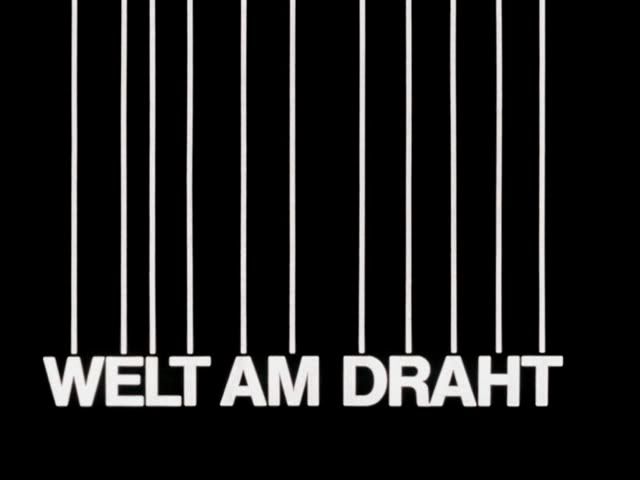
Welt am Draht / World on a Wire (PART I)
Directed by Rainer Werner Fassbinder, (1973)
We put together a pamphlet on cybernetics for the screening get it:

Rainer Werner Fassbinder’s visionary science-fiction thriller originally made for German television in 1973. 

[World on a Wire is] a very beautiful story that depicts a world where one is able to make projections of people using a computer. And, of course, this leads to the uncertainty of whether someone himself is a projection, since in the virtual world projections resemble reality. Perhaps another, larger world has made us as a virtual one? In this sense it deals with the old philosophical model, which here takes on a certain horror. Fassbinder
Based on Daniel F. Galouye's novel "Simulacron Three" Rainer Werner Fassbinder’s 2 part TV production is a science-fiction classic that explores the notion of a computer-generated other world, pre-dating The Matrix by 26 years. Since its original broadcast in 1973 it has rarely been seen and following increasing demand the Fassbinder Foundation have restored this remarkable film.

Simulacron 1 is a highly advanced project, designed to take computer technology to a new level by creating another world inhabited by computer-generated people or ‘identity units’ that will help to predict future events. When the head of the project dies mysteriously after showing signs of mental disturbance, Dr Stiller becomes his successor. However, Stiller also begins to behave bizarrely. He speaks of people disappearing whom no one else knows, believes someone is trying to murder him and has nausea attacks. As he begins to probe deeper into Simulacron, the line between the real and virtual world becomes increasingly blurred and his own existence is questioned. 


Tuesday, 12 March 2013

Sunday 31 March Welt am Draht / World on a Wire (Part II)


Welt am Draht / World on a Wire (Part II)
Directed by Rainer Werner Fassbinder, (1973)

Thanks to overwhelming popular request, we'll be screening part II of Fassbinder's science fiction, World on a Wire this March.

WE'LL BE SCREENING AT the same LOCATION WATCH THE MAILING LIST FOR DETAILS

Rainer Werner Fassbinder’s visionary science-fiction thriller originally made for German television in 1973. 

[World on a Wire is] a very beautiful story that depicts a world where one is able to make projections of people using a computer. And, of course, this leads to the uncertainty of whether someone himself is a projection, since in the virtual world projections resemble reality. Perhaps another, larger world has made us as a virtual one? In this sense it deals with the old philosophical model, which here takes on a certain horror. Fassbinder
Based on Daniel F. Galouye's novel "Simulacron Three" Rainer Werner Fassbinder’s 2 part TV production is a science-fiction classic that explores the notion of a computer-generated other world, pre-dating The Matrix by 26 years. Since its original broadcast in 1973 it has rarely been seen and following increasing demand the Fassbinder Foundation have restored this remarkable film.

We put together a pamphlet on cybernetics for the screening get it

Cybernetics recomposes globally and organically the functions of the general worker that are pulverised into individual micro-decisions: the bit links up the atomised worker to the figures of the Plan.  -- Romano Alquati 1963, p. 134 (translation mine). Quoted in Pasquinelli, p.6


The Cybernetic Hypothesis is thus a political hypothesis, a new fable that after the second world war has definitively supplanted the liberal hypothesis. Contrary to the latter, it proposes to conceive biological, physical, and social behaviors as something integrally programmed and re-programmable. More precisely, it conceives of each individual behavior as something “piloted,” in the last analysis, by the need for the survival of a “system” that makes it possible, and which it must contribute to.-- Tiqqun, ‘Cybernetic Hypothesis’ 

'The mass-produced hermit came into being as a new human type, and now millions of them, cut off from each other, yet identical with each other, remain in the seclusion of their homes. Their purpose, however, is not to renounce the world, but to be sure they won't miss the slightest crumb of the world as image on a screen.  
-- Gunther Anders, ‘The World as Phantom and Matrix, 1956.


Resources: 
Midnight Notes, ‘Conversation with a Demon’,
http://ge.tt/api/1/files/6Q0dvQa/0/blob?download

Tiqqun, ‘Cybernetic Hypothesis’, originally published in Tiqqun II, 1999 http://theanarchistlibrary.org/library/tiqqun-the-cybernetic-hypothesis

Gunther Anders, ‘The World as Phantom and Matrix, 1956.
http://thiva.egloos.com/2023093 

Matteo Pasquinelli text, with some translations of Romano Alquati's early work on cybernetics.
http://ge.tt/api/1/files/40VrLRa/0/blob?download

Graphics/Texts from http://www.processedworld.com/

Short text on Anders, Molussia: http://cinema-scope.com/features/burrus-abominable-dialectic-nicolas-reys-autrement-la-molussie/


A Situationist texts on Cybernetics; 'All the King's men': http://www.bopsecrets.org/SI/8.kingsmen.htm
Guy Debord's 'Correspondence with a Cybernetician' (in French arghh): http://i-situationniste.blogspot.co.uk/2007/04/correspondance-avec-un-cyberneticien.html

Monday, 11 March 2013

Noreen MacDowell and Isaac Julien Screening 28th March, 2013


As a special celebration of the life of Noreen MacDowell whose films on the Grunwick Strike we screened some time ago we're collaborating on a screening at n.o.w.here lab this thursday.

Full Unemployment Cinema
Noreen MacDowell and Isaac Julien


Thursday, 28th March, Free, 7pm

no.w.here, 316-318 Bethnal Green Road, E20AG


A special anniversary screening of two films made by Noreen MacDowell with the Newsreel Collective followed by Frantz Fanon, an early film by Isaac Julien. This screening is hosted at no.w.here and is put on in collaboration with Full Unemployment Cinema and John Barker. 

Full Unemployment Cinema 
A bunch of no good commies and anarchists showing films about work and the struggles against it since November 2007 

http://unemployedcinema.blogspot.co.uk/ 
twitter: #uncine 

n.o.w.here lab
http://www.no-w-here.org.uk/index.php?cat=1&subCat=docdetail&&id=354


True Romance, 1981 
Made by Noreen MacDowell when she was squatting in Bow and features the youth of the area (including a very young Isaac Julien talking about sex), and then themselves improvising a party in which some of what is said is lived/acted out. 

Divide and Rule Never Again, 1978, 40 min, 16mm, projected DVD 
Divide and Rule Never Again by Noreen MacDowell set in Bow is about race interviewing Bengali youth and some white racists but ends with the triumph of the huge Rock Against racism gig in Victoria Park. 

Frantz Fanon: Black Skin, White Mask, 52 mins, 1996 
A film exploring the pre-eminent theorist of the anti-colonial movements of this century. Fanon's two major works, Black Skin, White Masks and The Wretched of the Earth, were pioneering studies of the psychological impact of racism on both colonized and colonizer. Isaac Julien integrates the facts of Fanon's brief but remarkably eventful life with his long and tortuous inner journey. Julien elegantly weaves together interviews with family members and friends, documentary footage, readings from Fanon's work and dramatizations of crucial moments in Fanon's life. Cultural critics Stuart Hall and Françoise Verges position Fanon's work in his own time and draw out its implications for our own.

Monday, 5 November 2012

Death Laid an Egg


25th November 2012
Colorama II, Lancaster Street London SE1
Doors open 7PM
Film at 7.30PM

DEATH LAID AN EGG [La morte ha fatto l'uovo]
Giulio Questi - Italy, 1968

This is a deliriously strange thriller about a scientist (Jean-Louis Trintignant) who is breeding headless, boneless chickens at a high-tech farm. He's having an affair with Ewa Aulin, who is plotting with him to kill his wife (Gina Lollobrigida)...and she's plotting with Aulin to kill him...and he and Lollobrigida are plotting...oh, it's too confusing, but extremely memorable. 

The bizarre, only semi-linear editing and trippy cinematographic techniques are artifacts of the psychedelic era and combine with the twisted story to make any Euro-cultist's dreams come true. A film that defies easy categorization, it veers uneasily between giallo, drug film, and science-fiction, with heavy doses of romance and Antonioni-like weirdness. 


It was the time of the economic boom. The process of industrialization was a growing tide that swept everything away. It was a hymn to the future, a frenetic packaging of products without distinction between animate and
inanimate. Products that were still alive were screaming in terror and anguish. Large factory farms were a symbol of this. Every man was a chicken, every hen a woman, every chick a child. Wealth was accumulated on their skin. And, above all, "the egg" triumphed; white, smooth, perfect, with a life locked inside it. Sexual perversion became the only possible way out. 

G. Questi


FRRRRREE, as usual. 

Venue confirmed

Colorama II, Lancaster Street London SE1 
(not the old colorama, but the building next door)
More info watch this space | or the twitter space 
@un_cine | or FB Full Unemployment Cinema


There's an informative post on the film here:  
http://sonofcelluloid.blogspot.co.uk/2012/01/death-laid-egg-1968.html

Extract:

The factory is the real villain of the film - the modern technology implemented by the matriarchal owner Anna has eliminated the need for human workers. The process has become entirely automated and the unemployed workers seethe with undisguised hate and resentment. The factory is coveted by Gabrielle and Mondaini and their thirst for the wealth it is about to generate motivates murder and duplicity. It is also the site for a series of monstrous and grotesque experiments, the culmination of which is the birth of a mutated headless chicken. Its destruction the only sensible thing that the confused and emasculated Marco does. His capitalist overlords however are less than happy with this, their eyes shine with greed at the prospect of a poultry product which will have no waste attached to it. If this isn’t enough the factory even claims the life of a harmless pet dog! The critique of capitalism and aggressive mechanised production techniques emerges as the most salient theme of the film. It feeds into a general sensibility of inhumanity which is reflected in the cynical and selfish behaviour of the main characters.


Friday, 2 November 2012

There's No Whiteness 4 November 7pm

T4 November | 7pm | Free

Upstairs at Freedom Bookshop / Autonomie Club

Angel Alley 84b Whitechapel High Street London E1 7QX

The White Bus (1967)
Directed by Lindsay Anderson, 46 mins)
Written by Shelah Delaney


The Man in the White Suit (1951)
Directed by Alex Mackendrick, 85 mins


The White Bus (1967)
Directed by Lindsay Anderson, 46 mins
Written by Shelah Delaney

Lindsay Anderson and Shelagh Delaney's The White Bus is a surrealistic film about a secretary who takes a strange trip, part of which takes place on the eponymous vehicle. The nameless girl has a seemingly dull life, which is interrupted by periodic flights of fantasy involving suicide, recreations of paintings, and pieces of meat that suddenly run blood-run. Between these fantasies are the details of her real life, especially as she begins a journey home to visit her family. She encounters a wide variety of people -- a teen-ager exceedingly angry that his rubgy team has lost a match, a young man who proposes marriage, a lord mayor who enjoys feeling her leg -- as she travels to locations ranging from a community center and a public library to a natural history museum and a civil defense demonstration. Along the way, the girl maintains a façade of passivity, even when events become quite surreal, as when all of her traveling companions turn into human dummies during the civil defense drill. At the end of the film, she enters a restaurant and eats dinner while the owners pile chairs on the tables around her, obscuring her from view and complaining about the never-ending pace of work. 


The Man in the White Suit (1951)
Directed by Alex Mackendrick, 85 mins

A classic Ealing comedy running fast out of  wartime austerity into a post-war rearrangement of class, capital and technology about combine again in a headlong collision. The films central tension makes for an interestingly prescient take on theories of communisation: "A young scientist invents a material that is indestructible and repels dirt. He soon finds himself caught between the moguls of the textile industry and the trade unions, all equally determined that his invention never sees the light of day." - Screenonline


The Man in the White Suit is a whirling mess: of sabotage and complicity, of things falling apart against the threat of never falling apart.  A desperate, clinging defense - capital and labor, all together now, or we're all fucked! - in the name of decay and forced obsolescence.  A coming together as a nasty collective (headed up by arch-capitalist Sir John Kierlaw, seen above with cane, seen elsewhere haunting the dreams of child labor, a Dark Crystal Skeksis of textile monopoly, his laugh a hissing poisonous exhalation that has to be declared after the fact to have been laughter ) to destroy to protect the order of things that are destroyed, run-down, and cast out "naturally."

Essay by E.C.W. - http://socialismandorbarbarism.blogspot.co.uk/2010/06/its-just-suit-it-looks-as-if-its.html

Tuesday, 23 October 2012

Mouvement Communiste and Unicode WildCat Present:
THE SUSPENDED YEARS 
Movements and Political Journeys in Porto Marghera
Manuela Pellarin, 2009, 49 min. In Italian with English subs.
Sunday 28 October at 7.30 pm. 
Pullens Centre, 184 Crampton street, Elephant and Castle, London SE17 3AE

The film will be preceded with an introduction by the translator into French of a book ('Workers’ Power in Porto Marghera') and an open discussion. 

 The 'Suspended Years' is concerned with the intense series of workers’ struggles which took place in and around the chemical production plants of Porto Marghera (close to Venice) in north eastern Italy, starting in the mid-1960s up until the late 1970s. The Porto Marghera workers became one of the emblematic figures of the whole experience of “workers autonomy” in Italy in this period, alongside the Fiat workers. They were part of a movement which began in the factories but which rapidly spread far beyond the factory walls, to encompass and question the whole of social life under capitalism.
A previous film produced about the Porto Marghera workers by the same director was “The last firebrands” (“Die Jetzten Feuer”) distributed by the German group Wildcat.
The film consists of a series of interviews with participants in these momentous events, including workers in the plants, students from Venice and Padua, and activists involved in such things as “self-reduction” in supermarkets… The interviews were made between 2004 and 2008.

A bit of background
The people interviewed in this film are describing an experience of workers autonomy in Italy between 1968 and 1980, that of the Workers Committee of Montedison in Porto Marghera (1968-1972), which was closely related to that of other workers committees in the region, including those of Chatillon, and AMMI. Starting in  November 1972, these committees transformed themselves into a Workers Assembly, which regrouped many other committees in the Venetia region, but it was the Workers’ Committee of Montedison which remained the real point of reference for all the committees of the province.

The committee was born in a big chemical plant which at the time employed 3000 labourers and 1000 technicians. It was formed from young militant workers in the plant, some of whom had been activists in the union and the CP and others who were completely new to politics. The questions that they asked themselves about their condition in the factory led them to establish contact with people from the group Potere Operaio, who had been handing out their leaflets at the gates of the factory since the winter of 1965-66. Many workers in the plant became involved in Potere Operaio, and some of the interviews in the film are directly concerned with the relationship between the workers inside the plant and the students and intellectuals who have a more “external” relation to workers’ struggles.


All this organisation and agitation began to have a profound impact during 1968. In July of that year there was a strike for better pay and conditions launched by the committee which would become known throughout Italy when, on 1 August, a strikers’ demonstration blockaded the Mestre train station and fought with the police.

Like all expressions of workers autonomy at this time, there were certain demands within workplaces which everybody put forwards - uniform increases of wages, reduction of wage differentials between different categories of workers, equalisation of benefits between workers and white-collar employees, reduction of the pace of work, breaking the division between directly employed and subcontracted workers, etc. And the same methods of struggle were always advocated - organisation into assemblies at the workshop and the factory level, marches through the factory to spread and enforce strikes, the refusal of delegation, etc. But they also intervened outside the factory around various issues – transport (refusing to pay fares), housing (occupations, forcing down rent), reducing electricity bills, and the cost of living in general (against price increases in bakeries and supermarkets).

But the struggles of Porto Marghera also had their own specificities. A particularly important factor was the presence of highly skilled technicians who understood the production process. This was combined with a “workers’ enquiry” that the committee had consciously carried out so as to understand the functioning of the plant and how workers could exploit its weak points. As a result of this, the workers could completely shut down the plant during a strike, even though the bosses had told them it was impossible. Just to make sure that we get the importance of this, a worker explains it twice in the film!

Something else which was specific to Porto Marghera (although not that specific) is the “noxiousness” of their work in the chemical factory (particularly in the vinyl chloride section) and their refusal to accept it, by adopting the principle that “if our working environment  is toxic we’ll try to be there as little as possible” and making the boss pay for the treatment which they had to have.

They went on to critique the consequences of production on the surrounding region and so are perhaps the first “ecologists” to refuse the deadly aspect of capital and to call into question wage labour itself. As the film points out at the end, many worker activists died relatively young as a result of cancers caused by exposure to substances such as vinyl chloride monomer.

The title?
The title – Gli anni sospesi - is taken from the name of a conference which was held in Porto Marghera in 2007 entitled “The 1970s – the suspended years”. But why “suspended”?
Well, perhaps we can say that the period of intense struggle that was the 1970s can be seen as “suspended” in time and space, separate from what came before and after, waiting for something new ahead but not yet in focus or determined… Perhaps.

The film was originally intended to be distributed as a DVD with the book Quando il potere è operaio - Autonomia e soggettività politica a Porto Marghera (1960-1980) [“When power is the worker - Autonomy and political subjectivity in Porto Marghera (1960-1980)"], Rome, Manifestolibri, 2009. The book was recently published in French as Pouvoir ouvrier à Porto Marghera - du Comité d’usine à l’Assemblée de territoire (Vénétie – 1960-80) [“Workers’ Power in Porto Marghera – from the Factory Committee to the Territorial Assembly (Venetia – 1960-80)”], Editions Les Nuits Rouges, 2012.
However, the film stands perfectly well on its own, both as a historical document about the workers’ movement in Italy and as a discussion around the more global themes of the relationship between struggles inside and outside workplaces, between militant workers and “external activists” and even “ecological” questions of shutting down poisonous and environmentally destructive workplaces…

Some useful links:
The classic text “The Refusal of Work”, produced by the Workers’ Committee of Porto Marghera in 1970: http://libcom.org/library/refusal-work-workers-committee-porto-marghera-1970

For those of you who read Italian, here are some editions of the magazine Lavoro Zero (“Zero Work”) that some of the interviewees were involved with: http://www.chicago86.org/archivio-storico/lotte-operaie-anni-60-70/lavoro-zero.html

And why not take a look at the “operaismo” section of libcom?: